
Every hiring conference in 2026 opens with the same message: the degree is dying, and skills are king. As a recruiter, I hear it constantly, and there is real truth to it. But there is also a gap between what employers say about skills-based hiring and what they actually do, and understanding that gap is where the real opportunity lies for both companies and candidates.
So let me walk through what is genuinely happening, and what it means for you.
The shift is real
The move toward skills-based hiring, evaluating candidates on demonstrated ability rather than degrees, is not just talk. The numbers behind it are significant.
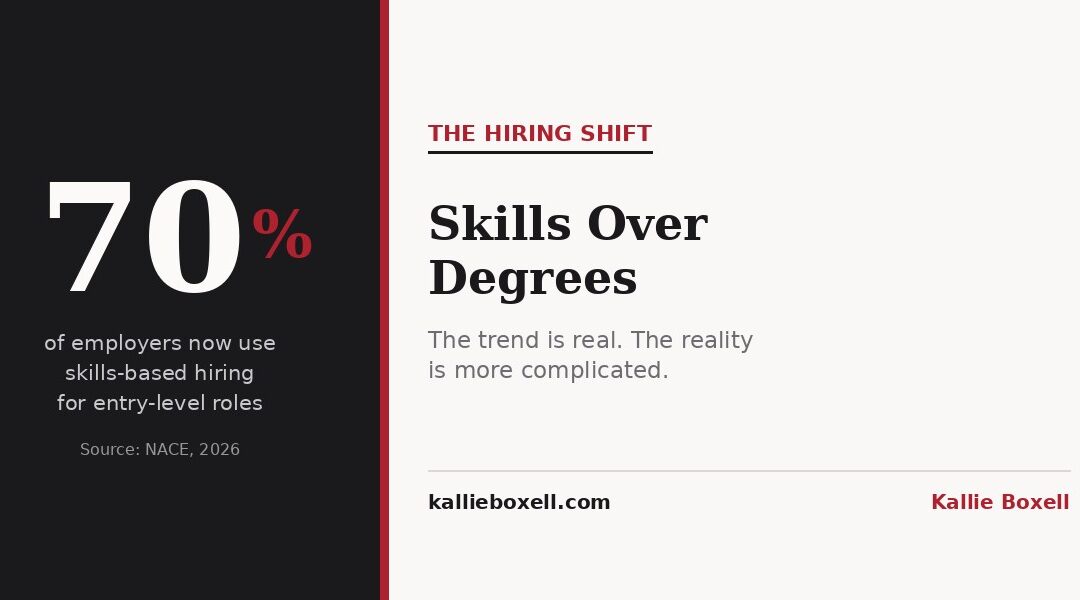
- About 70 percent of employers now use skills-based hiring for entry-level roles, up from 65 percent a year earlier, per the National Association of Colleges and Employers (NACE).
- Around 53 percent of employers have removed degree requirements from at least some job postings.
- Hiring for skills is roughly five times more predictive of job performance than hiring on education alone, according to McKinsey.
- Evaluating candidates by skill instead of degree can expand a talent pool by up to ten times, per LinkedIn’s Economic Graph research.
Major employers including Google, IBM, Delta Air Lines, and Bank of America have formally dropped the four-year degree requirement for many roles, and the trend has spread well beyond technology into finance, aviation, and retail. This is a structural shift, not a fad.
Why employers are making the change
Three forces are driving this, and all of them are practical rather than idealistic.
- The talent shortage. There are more open roles than available workers in many fields, and employers simply cannot afford to shrink their own candidate pools with unnecessary requirements. This pressure is especially acute in skilled fields, a challenge I explored in my piece on the manufacturing talent shortage.
- The skills gap. Plenty of degree holders lack the practical skills a job needs on day one, while plenty of non-degreed workers have built exactly those skills through experience, certifications, or self-directed learning.
- Better matching tools. Technology now makes it far easier to assess actual skills rather than relying on a credential as a shortcut, which connects to how I have written about using data and AI to find great hires.
The honest part nobody puts on the conference slide
Here is where I want to be straight with you, because this is the detail that separates informed hiring from hype.
A widely cited analysis by Harvard Business School and the Burning Glass Institute looked at what actually happened at companies that publicly committed to skills-based hiring. They found that while the share of job postings requiring a bachelor’s degree has fallen, the share of new hires without a four-year degree at those same companies barely moved. Researchers have called it the “85 percent versus 0.14 percent paradox,” because so many employers claim skills-based hiring while the actual change in who gets hired has been tiny, closer to one in 700 new hires.
This does not mean employers are lying. It means that removing a degree line from a job posting and actually changing who you hire are two very different things. Old habits run deep. Someone in the room still asks where the candidate went to school.
What this means if you are hiring
For employers, the lesson is that a policy change is not enough. If you want the real benefits of skills-based hiring, wider pools, better performance, stronger diversity, you have to change the practice, not just the posting.
- Define the actual skills a role requires, and build your screening around them.
- Use practical assessments and scenario-based interviews instead of leaning on pedigree.
- Train your hiring managers to evaluate demonstrated ability, and hold them to it.
- Accept credible certifications and portfolios as real evidence, not lesser substitutes.
What this means if you are job hunting
For candidates, the shift is genuinely good news, but you have to meet it halfway.
Make your skills impossible to miss. Do not bury them under job titles and dates. Show what you can actually do, with specifics, certifications, and examples of real work. And prepare for the practical assessments that increasingly replace the traditional “tell me about yourself” interview, a mindset that pairs well with how I have encouraged candidates to think when they evaluate a job offer and approach the process as equals.
The bottom line
Skills-based hiring is real, it is growing, and it is reshaping how companies find talent. But the gap between the headline and the hire is still wide, and the employers who close it will have a genuine edge in a tight market.
Say what you mean, then actually do it. In hiring, as in most things, that is where the real advantage lives.